The unstretched length of spring AB is 3 m. If the block is held in the equilibrium position shown, determine the mass of the block at D.
Image from: Hibbeler, R. C., S. C. Fan, Kai Beng. Yap, and Peter Schiavone. Statics: Mechanics for Engineers. Singapore: Pearson, 2013.Let us first determine the stretched length of spring AB. We can use Pythagorean theorem to figure this out.
Length of spring =A 55kg bungee jumper leaps from a bridge. She is tied to a bungee cord that is 13m long when unstretched, and falls a total of 31m. A) Calculate the spring constant k of the bungee cord assuming Hooke's law applies. B) Calculate the maximum acceleration she experiences. Express answers using two significant figures. A vertical force P = 10 lb is applied to the ends of the 2-ft cord AB and spring AC. The spring has an unstretched length of 2 ft. Take k = 21 lb/ft. Determine the angle theta for equilibrium. Express your answer using three significant figures. 1 Answer to Each spring has an unstretched length of 2 m and a stiffness of k = 330 N/m.(Figure 1) Part A Determine the stretch in OA spring required to hold the 18- kg crate in the equilibrium position shown. Express your answer to two significant figures and include the appropriate units. Part B Determine. In this video,I go over another dynamics problem that explores the idea of the spring force as well as dynamic movement. The key to this problem is understan.
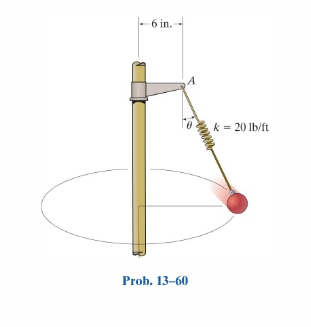
(25 pts) The spring has a stiffness k = 50 lb/ft and an unstretched length of 2 ft. As shown in the figure below, it is confined by the plate and wall using cables so that its length is l = 1.5 ft. A 4-lb block is given a speed v A when it is at A, and it slides down the incline having a coefficient of kinetic friction μ k = 0.2.
sqrt{4^2+3^2}Length of spring = 5 m
We know from the question that the unstretched length of the spring is 3 m. That would mean the spring stretched by 2 m (5 m – 3 m = 2m) after the block was hung at ring A.
We can now figure out the force of spring AB using Hook’s Law.
Hook’s Law states:F,=,ksA Spring Having An Unstretched Length Of 2 Ft =
Let us now draw our free body diagram.
The angles were calculated using the inverse of tan (arctan).
The brown angle was found by: text{tan}^{-1}left(dfrac{3}{3}right),=,45^0
The orange angle was found by:
text{tan}^{-1}left(dfrac{3}{4}right),=,36.87^0A Spring Having An Unstretched Length Of 2 Ft Lauderdale
The next step is to write our equations of equilibrium.
A Spring Having An Unstretched Length Of 2 Ft X 8
m,=,dfrac{84}{9.81}
mass = 8.56 kg